

Green Infrastructure Community-of-Practice is the online home for EAP, the Ecological Accounting Process, which is an initiative of the Partnership for Water Sustainability for British Columbia

“Commencing with a launch announcement by the BC Minister of Environment in 2005, this community-of-practice has served an important function as the home for green infrastructure in British Columbia. Originally created to support the work of the Green Infrastructure Partnership, the community-of-practice now has a dual focus in supporting two interconnected initiatives, that is: EAP, the Ecological Accounting Process: and Asset Management for Sustainable Service Delivery in BC, which is led by Asset Management BC,” stated Mike Tanner, Waterbucket Chair.
HOW WE CHANGE WHAT WE ARE DOING ON THE LANDSCAPE: Synthesis Report on EAP, the Ecological Accounting Process, a BC Strategy for Community Investment in Stream Systems (released by the Partnership for Water Sustainability, June 2022)

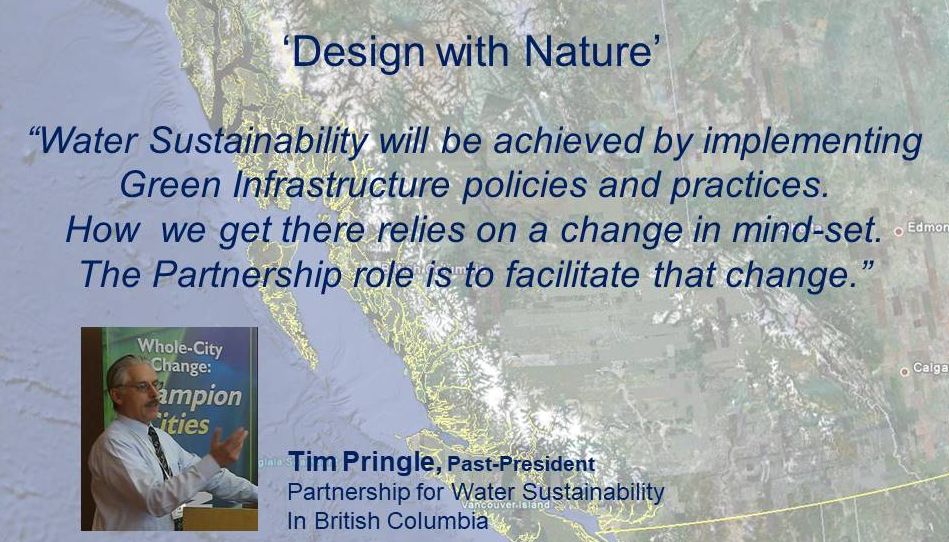
“In 2016, the Partnership embarked upon a 6-year program of applied research to evolve EAP through a 3-stage building blocks process of testing, refining, and mainstreaming the methodology and metrics for financial valuation of stream systems. The program involved 9 case studies and 13 local governments and yielded 19 “big ideas” or foundational concepts. The program goal was to answer the question, how much should communities budget each year for maintenance and management of stream systems,” stated Tim Pringle.
HISTORY OF GREEN INFRASTRUCTURE IN BRITISH COLUMBIA: “The Partnership for Water Sustainability is the keeper of the GIP legacy,” stated Paul Ham, a Past-Chair of the Green Infrastructure Partnership

During the period 2003 through 2010, the Green Infrastructure Partnership played a prominent role in leading change and assisting with implementation of the Water Sustainability Action Plan for British Columbia, primarily in the Metro Vancouver region. “I see my years of chairing the GIP as helping to get the ball rolling and ideas disseminated, on green infrastructure, all of which has subsequently been taken up by others to a much greater degree of implementation and success. Our efforts a decade ago moved the state of-the-art of green infrastructure to a more mainstream level,” said Paul Ham.
FLASHBACK TO 2007: What is “Green Infrastructure”? Looking back to understand the origin, meaning and use of the term in British Columbia

In 2007, the first Beyond the Guidebook guidance document provided a clear distinction between natural and engineered green infrastructure. “Two complementary strategies can ‘green’ a community and its infrastructure: first, preserving as much as possible of the natural green infrastructure; and secondly, promoting designs that soften the footprint of development,” wrote Susan Rutherford. “Green infrastructure design is engineering design that takes a ‘design with nature’ approach, to both mitigate the potential impacts of existing and future development and growth and to provide valuable services.”
EAP, THE ECOLOGICAL ACCOUNTING PROCESS, IS A FINANCIAL TOOL TO HELP STREAMS SURVIVE: “We are in a 3-year transition strategy to embed EAP at Vancouver Island University. We can see the many directions EAP could take,” stated Anna Lawrence, Project Coordinator, Mount Arrowsmith Biosphere Region Research Institute at VIU

“There are so many different parts to EAP. And with each part you can go down a distinct pathway that helps local governments. I am very focused on the 3-year transition strategy because Year One was just trying to absorb as much knowledge as possible. It was a juggling process with many moving parts and trying to keep them all in balance. But Year One is now behind us. We are envisioning other areas of research as potential EAP projects.. And so, we look forward to sharing our EAP experience at the BC Land Summit,” stated Anna Lawrence.
DELTA’S RAIN GARDEN PROGRAM FOR STREETSCAPE REVITALIZATION: “The road designers are taking the initiative to incorporate linear rain gardens,” stated Harvy Singh Takhar, Utilities Engineer with the City of Delta in Metro Vancouver

“By working with the roads people on curb cuts, we have actually come up with variations. Our original detail was quite generic. Now we are able to implement it in various types of curb designs. We are striving to make sure that rain garden maintenance is as easy as possible, including inlets and outlets for drainage. We have evolved the designs so it is EASY CLEAN for all the sediment buildup. Our crews can quickly scoop it with a shovel and be on their way! That change resulted from feedback from engineering operations staff regarding what they wanted to see. We just evolved the design as per their operational needs,” stated Harvy Takhar.
DESIGN WITH NATURE TO CREATE LIVEABLE COMMUNITIES AND PROTECT STREAM HEALTH: “Broaden our standards so that we have the plethora of solutions on the table. It starts with education, at both the institutional and government levels, to understand why green infrastructure is necessary. And then, apply those broader solutions,” stated Hugh Fraser, former Deputy Director of Engineering, City of Delta

“Drainage is but a sub-set of municipal engineering. Historical engineering practice did not consider some of the broader objectives that we now try to address through green infrastructure. Drainage in the context of urban planning and development decisions has historically been an afterthought,” stated Hugh Fraser. “Delta urban areas are built out. The municipality is effectively limited to retrofitting of rain gardens within road corridors in order to provide rainwater infiltration that protects stream health. Road rights-of-way account for one-third of the land area of a typical urban watershed.”
DESIGN WITH NATURE TO CREATE LIVEABLE COMMUNITIES AND PROTECT STREAM HEALTH: “There was tension between stakeholders. Yet the productiveness of those dialogues inspired a lot of professionals, myself included, to dig deeper and find solutions and learn. You felt like you were part of a movement,” recalled Susan Haid, career environmental and urban planner in BC local government

Susan Haid has played a leadership role in trailblazing an ecosystem-based approach to community planning in British Columbia. “The 1990s was a very instrumental time of policy and regulation development. And municipal dialogue too. The discussions around the Fish Protection Act had a huge influence shifting perspectives to a bigger scale. The course that I teach at UBC is about how policy frameworks shape urban design. Building in resiliency to our cities from the site level to the regional level could NOT be more critical than now,” stated Susan Haid.
REFLECTIONS ON CREATING A CULTURE OF APPRECIATION IN THE CITY OF COQUITLAM: “Balance. Alignment. Appreciation. Three words that capture so much. They are foundation pieces for creating a culture of collaboration which is a steppingstone to a culture of appreciation,” stated Pete Steblin, former City Engineer and City Manager

“Good decision-making comes down to a good process. But it also relies on wisdom in terms of balanced advice. The essence of my guiding philosophy as a City Manager is distilled into the three Ts which are trust, time and think. Staff gives good advice and Council makes the decisions,” stated Pete Steblin. “When there is a significant level of trust in technical recommendations, Councils rarely override them. Staff explains recommendations. The Council makes the decisions. Trust is fragile and can easily be broken. When trust is lost, decades of good work can be lost.”
EAP, THE ECOLOGICAL ACCOUNTING PROCESS, IS AN EXPRESSION OF BLUE ECOLOGY: “Both are all about a restorative framework and mindset. This means restoring the interconnectivity and function of natural systems in a way that truly represents their importance,” stated Richard Boase, career environmental champion within local government
“We must do a better job of protecting streams. I am in a position now to reflect on this because I believe I have earned that right over the course of a 30-year career. Given how much I have seen, done and been exposed to in my local government career, it is fair for me to reflect on what has happened and comment on why local governments have not been as successful as we would have wanted. But we must focus on the path forward so that we protect or enhance stream systems in the built environment,” stated Richard Boase.
DESIGN WITH NATURE TO CREATE LIVEABLE COMMUNITIES AND PROTECT STREAM HEALTH: “Replacement of curb-and-gutter with a blue link rain garden is a perfect illustration of integration in action. I said to staff just do it,” stated Ramin Seifi, former General Manager of engineering and planning with Langley Township in the Metro Vancouver region

Langley’s approach to achieving water balance through green Infrastructure evolved as successive neighbourhoods were built over the past two decades. In the beginning, the focus for Green Infrastructure was on what could be achieved within greenways. Langley staff then turned their attention to rain gardens. Building on their history of successes, their next evolution was implementation of “blue links”, which is another name for rain gardens. The blue link is symbolic of the transformational change which has taken root in the Township in the 21st century as designing with nature became the ‘new normal’.
ASSET MANAGEMENT FOR SUSTAINABLE SERVICE DELIVERY: “A truly wise person remains teachable their entire lives, always curious and open to hearing new ideas and learning new things,” wrote Bernadette O’Connor, Editor, in the Winter 2024 issue of the Asset Management BC Newsletter IN BRITISH COLUMBIA:

“The term deep knowledge is generally referring to the effective sharing of knowledge that has been informed by a lot of experience. Thus, a work environment that encourages exploring and adapting to new knowledge as well as sharing senior knowledge and learned experience will generate better problem solvers and decisions. A balanced method to form institutional knowledge will draw benefit from the knowledge and experience of senior staff without discounting the contribution of new ideas, approaches, and information,” wrote Bernadette O’Connor.
ASSET MANAGEMENT FOR SUSTAINABLE SERVICE DELIVERY: “Knowledge transfer is a broken process in local government,” stated Kim Stephens, Partnership for Water Sustainability (Winter 2024 issue of Asset Management BC Newsletter)

“Organizational and intergenerational amnesia is real and has a downside. It results in unintended consequences. Superficial understandings do not yield solutions to complex problems. One needs deep knowledge. The ramifications of amnesia are cause for concern in an era when systems of all kinds are being subjected to repeated shocks that test their resiliency. At the same time, councils and boards are grappling with top-down decisions or directives by senior governments. But how effective can they be when knowledge transfer in local government is broken?” asked Kim Stephens.
ASSET MANAGEMENT FOR SUSTAINABLE SERVICE DELIVERY: “We get a wide variety of education and skill sets on Councils and Boards often with very different interests. This makes communications complex and challenging,” stated Christina Benty, a former mayor of Golden in southeast British Columbia (Winter 2024 issue of Asset Management BC Newsletter)

“There are two young fish swimming along who happen to meet an older fish. The older fish nods at them and says: ‘Morning boys, how’s the water?’ The two young fish swim on for a bit and then eventually one of them looks over at the other and asks: ‘What the hell is water?’ The story also begs the question, what makes the older fish so much wiser? We must infer that it is his experience. That is, the older fish only knows about water because he’s been either outside the fishbowl or in many different fishbowls,” wrote Christina Benty.